Interactive Voice Response (IVR) services are becoming a vital component of modern consumer communication for companies of all sizes. Nowadays, businesses get hundreds or even thousands of calls from clients every day. Manually handling these calls may result in delays, confusion, and unsatisfactory client experiences. By automating call management, directing callers through a structured menu, and swiftly connecting them to the appropriate department or information, IVR services address this problem.
To handle high volumes of incoming and outgoing calls, businesses from a variety of industries are implementing IVR software, cloud IVR solutions, and hosted IVR solutions. Many firms are looking for the Best IVR service provider in India or investigating the top IVR companies in India that can supply dependable communication infrastructure due to the quick rise of digital communication.
Understanding IVR Service in Simple Terms
Through voice commands or keypad inputs, callers can engage with a company’s phone system through IVR (Interactive Voice Response) services. The caller hears a pre-recorded menu with many selections rather than immediately chatting with a real agent.
For example:
- Press 1 for Sales
- Press 2 for Customer Support
- Press 3 for Billing Information
- Press 4 for Product Details
Voice recognition technology is also supported by modern IVR software, allowing users to communicate by simply speaking orders instead of entering numbers.
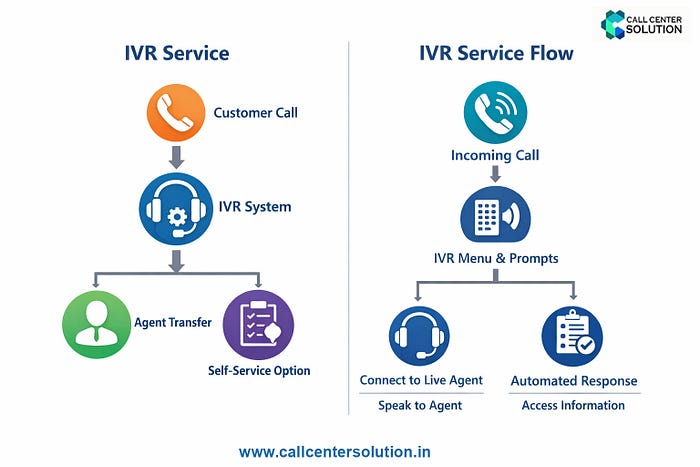
How an IVR System Works
Database integration, software, and telephone hardware work together to power an IVR system. The following procedure takes place when a consumer dials a company number linked to an IVR platform:
1. Call Reception
When a customer calls a business number connected to an IVR System in India, the system automatically answers the call with a welcome greeting.
2. Menu Options Presentation
A structured voice menu with several selections is played by the system. The purpose of these options is to direct the caller to the right department or service.
3. User Input Detection
The caller interacts with the IVR using:
- DTMF (Dual-Tone Multi-Frequency) keypad inputs, or
- Voice recognition commands
4. Automated Call Routing
The IVR system reviews the input and directs the call to the right agent, department, or automated response service once the user chooses an option.
5. Automated Information Delivery
Many cloud based IVR systems can provide instant responses such as:
- Account balance
- Order status
- Appointment confirmation
- Payment reminders

Types of IVR Systems Used by Businesses
Depending on their communication infrastructure and operational needs, businesses can select from a variety of IVR systems.
1. On-Premise IVR System
The internal design of the business is equipped with an on-premise IVR system. Businesses must handle upkeep and upgrades internally, but they retain total control over hardware and software.
2. Hosted IVR Solution
A third-party supplier oversees a hosted IVR system, which is housed on distant servers. Companies don’t need to maintain hardware because they can access the system online.
3. AI-Powered IVR
AI-based IVR systems, which use natural language processing understand spoken requests and provide highly Modified responses, are becoming more and more popular in modern businesses.
Read More: 6 questions to ask any IVR service provider
Conclusion
IVR services are now a key part of modern commercial communication. Whether businesses apply cloud-based IVR systems, hosted IVR solutions, or IVR software, the technology helps automate call handling, better customer satisfaction, and boost operational success.
Businesses may manage high call volumes, speed customer service, and streamline customer communication by utilizing IVR cloud telephony and cloud IVR solutions.
Explore more: https://medium.com/@callcentersolutionccs/top-6-questions-to-ask-any-ivr-service-provider-before-you-sign-up-cb2b80d9608f